I recently found myself in the unenviable position of having to defend technical complexity. It happened on an open science community call, just after my presentation on TMI-WEB, an open source qualitative data analysis tool we're launching later this year. Overall, our project stirred up a lot of interest and excitement, but one colleague on the call raised a challenging question: "Your software relies on technologies that are way outside the norm for most researchers. Aren't you afraid of creating technical barriers for people who might otherwise want to adopt this tool?" It's a valid concern, and one that my team shares. But as we've learned over the course of developing the system, the "normal" technologies that most researchers use by default are both technically and philosophically incompatible with our research focus. In fact, in our situation, there is an ethical case to be made for complexity.
I've worked as an engineer for over two decades, so I know very well that complexity is one of the cardinal sins of software design. Complexity can make it challenging for users to learn a new system and form a mental model of how it works. Complexity sometimes emerges when an inexperienced programmer falls prey to "techno-solutionism," the belief that technology is always the best tool for solving urgent problems (Morozov, 2013). I certainly went through a naive stage early in my career where I was full of "solutions" looking for problems to solve. My focus on the "what" and "how" of the software I was building far outpaced any thought about "for whom," let alone "why" I was building it. But that was a long time ago, and I've largely recovered from my youthful techno-optimism. TMI-WEB's complexity is the result of applied theory, not applied naivety.
TMI-WEB is a social science research platform being developed in a collaboration between DePaul University's IDentity Research Lab and the Organization for Ethical Source. We're designing the system for researchers studying how individuals self-identify and experience their complex identities, using what we call "intersectional datasets." "Intersectional" refers to intersectionality theory, a feminist philosophical framework based on the insight that characteristics such as race, gender, and class are not "unitary, mutually exclusive entities"; rather, these characteristics are compounding factors that reflect "complex social inequalities" (Collins, 2015). Intersectionality theory can explain, for example, how a young Black man with a disability may experience ableism differently than an older Latina woman with the same disability.
Our intersectional dataset is populated from a large-scale survey of college students, who were asked to reflect, in their own words, on how they experience different aspects of their social identities. Analyzing the survey results through an intersectional data lens honors the dignity and individuality of survey respondents while also revealing patterns across different identity dimensions. For example, masking, defined as "hiding behaviour that might be viewed as socially unacceptable" (Lai, 2017), is an adaptive strategy typically associated with autism spectrum disorder. But our analysis showed that this coping mechanism is also sometimes used by individuals identifying with religious or ethnic minorities, irrespective of neurodiversity. TMI-WEB's intersectional data model is specifically designed to surface these kinds of insights.
Systems designed in the context of the dominant culture are often ill-suited to studying groups at the margins of that culture. Many standard practices in data science are at odds with feminist principles, in part because these practices "perpetuate the illusion of value-free objectivity" (Tacheva, 2022). Data scientists insist that datasets must be "normalized" to be useful (Ali, 2014), structured and optimized specifically for computational or statistical analysis. For example, it is standard data practice to model race and ethnicity with a small, fixed set of predefined categories, reducing complex, highly individualized identities into "normal," but artificial and often arbitrary, classifications. There's little space in such approaches for data that is outside of these supposedly objective and value-free norms. In contrast, to support our research agenda—exploring the interconnected experiences of marginalized identities—we had to specifically design for messy, nonconforming data, because nonconforming data is the point of our work. As a result, we've had to adopt some unconventional approaches in order to meet our ethical responsibilities for handling this data. Our data model optimizes for humans, not machines.
A feminist, intersectional approach to data analysis calls for alternative frameworks that preserve context and nuance (D'Ignazio, 2020). In other words, TMI-WEB has to accommodate ambiguous, complex, and relational data at scale. Social psychologist Mary Brabeck wrote that "feminist ethics requires including those who have been left out" (Brabeck, 2021). We believe it also requires honoring the complexity of their identities, too. In the case of TMI-WEB, that means resisting the pressure to normalize or oversimplify our data. Our intersectional data model does not force individuals into static categories, reduce them to artificial binaries, or otherwise flatten their lived experiences. That kind of simplistic approach would result in the collateral erasure of some of the marginalized identities we are trying to study and understand, an ethically unacceptable tradeoff.
Good software engineers practice empathy, considering the diverse needs of the end user in every aspect of their design (Gunatilake, 2023). Ethical software engineers go one step further, designing systems that consider not only the needs of its users, but also the needs of the people the software is used upon—those who I call "collateral users" (Ehmke, 2022). Ethical software development calls on us to prioritize the dignity and agency of the subjects of the data (Mikhail, 2024) over the convenience of users of the system.
Most software developers would find it challenging to design an interface for navigating intersectional datasets. Since at least the 1990s, most user interfaces have imitated old-fashioned paper forms, presenting data fields as hierarchical, "structured collection[s] of variables" resting atop a database view (Choobineh, 1992). Going with such a "default" interface approach in TMI-WEB would have only digitally recreated the experience of thumbing through a binder full of hundreds of pages of printed paper forms. TMI-WEB can't adopt this form-based user interface paradigm, because intersectional datasets resist being reduced to hierarchical form fields.
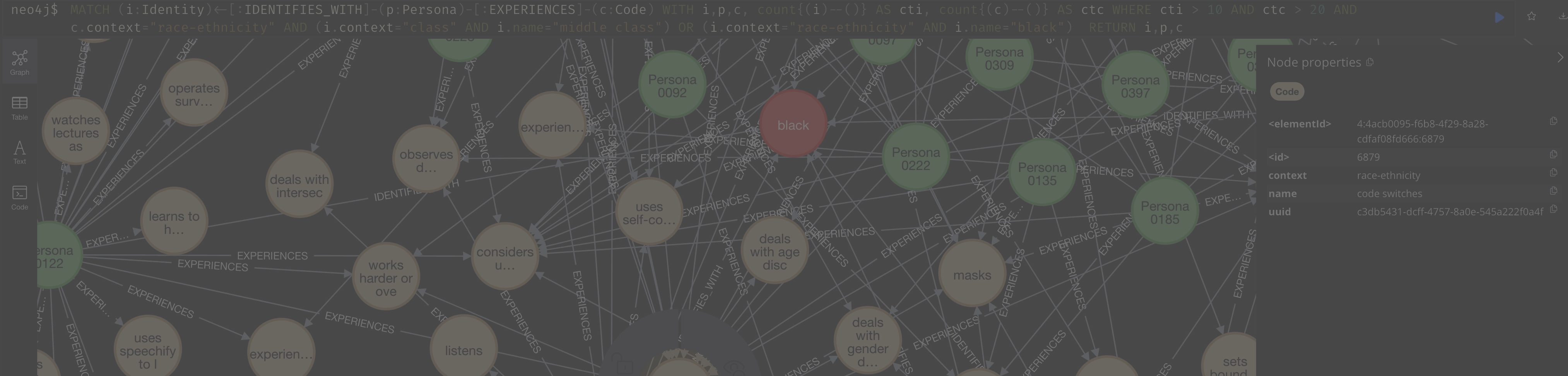
We specifically designed TMI-WEB's unconventional, multi-dimensional interface to surface nuanced relationships and patterns in identity data. Researchers can use it to explore intersectional datasets along different axes, vertically from the perspective of a single individual's responses or horizontally across groups formed not by demographic categories but by shared lived experiences. This enables inquiry and analysis through what Leurs might describe as "structures of individuality and collectives across intersecting axes of difference" (Leurs, 2017). TMI-WEB's unique interface makes the relationality of intersectional datasets tangible and navigable. Rather than sifting complex data down into census-like form structures, TMI-WEB presents intersectional datasets holistically, in a tactile, haptic network graph interface (Westbrook & Ehmke, 2026).
The ethical requirements for working with intersectional datasets continue to shape the evolution of our system design. It's true that this may make TMI-WEB more challenging for less technically confident researchers to learn how to use. This underscores the importance of providing carefully designed user interfaces, clearly defined workflows, and comprehensive, accessible documentation to ease the learning curve. Outside of the software itself, the research team is also developing rich multi-modal training materials and organizing co-design workshops to engage directly with researchers and practitioners to understand their needs and challenges.
Conducting social science research at scale while promoting feminist ideals of individual dignity and agency requires us to think differently about our data and the tools we use to model and analyze it. Sometimes this means stepping away from the familiar, the default, the "normal," and embracing complexity as an ethical imperative.
Ali, P. J. M., & Faraj, R. H. (2014). Data normalization and standardization: A technical report. Machine Learning Technical Reports, 1(1), 1–6. https://doi.org/10.13140/RG.2.2.28948.04489
Brabeck, M. M. (2021). Open science and feminist ethics: Promises and challenges of open access. Psychology of Women Quarterly, 45(4), 457–474. https://doi.org/10.1177/03616843211030926
Choobineh, J., Mannino, M. V., & Tseng, V. P. (1992). A form-based approach for database analysis and design. Communications of the ACM, 35(2), 108–120.
Collins, P. H. (2015). Intersectionality's definitional dilemmas. Annual Review of Sociology, 41, 1–20. https://doi.org/10.1146/annurev-soc-073014-112142
D'Ignazio, C., & Klein, L. (2020). The numbers don't speak for themselves. In Data feminism. MIT Press. https://data-feminism.mitpress.mit.edu/pub/czq9dfs5
Ehmke, C. A. (2022, November 30). Metagovernance seminar: The open social compact [Video]. Internet Archive. https://archive.org/details/ehmke-metagov-20221130
Gunatilake, H., Grundy, J., Mueller, I., & Hoda, R. (2023). Empathy models and software engineering—A preliminary analysis and taxonomy. Journal of Systems and Software, 203, 111747. https://doi.org/10.1016/j.jss.2023.111747
Lai, M.-C., Lombardo, M. V., Ruigrok, A. N., Chakrabarti, B., Auyeung, B., Szatmari, P., Happé, F., & Baron-Cohen, S. (2017). Quantifying and exploring camouflaging in men and women with autism. Autism, 21(6), 690–702. https://doi.org/10.1177/1362361316671012
Leurs, K. (2017). Feminist data studies: Using digital methods for ethical, reflexive and situated socio-cultural research. Feminist Review, 115(1), 130–154. https://doi.org/10.1057/s41305-017-0043-1
Mikhail, M. (2024). Data management in feminist research projects. In Doing feminist urban research (pp. 156–172). Routledge.
Morozov, E. (2013). To save everything, click here: The folly of technological solutionism. PublicAffairs.
Tacheva, Z. (2022). Taking a critical look at the critical turn in data science: From “data feminism” to transnational feminist data science. Big Data & Society, 9(2). https://doi.org/10.1177/20539517221112901
Westbrook, J. P., & Ehmke, C. A. (2026). Queer(ing) epistemology by design: TMI-WEB—A relational knowledge system for intersectional data science and affective queries. In L. Simeone et al. (Eds.), DRS2026: Edinburgh. Design Research Society. https://doi.org/10.21606/drs.2026.483